
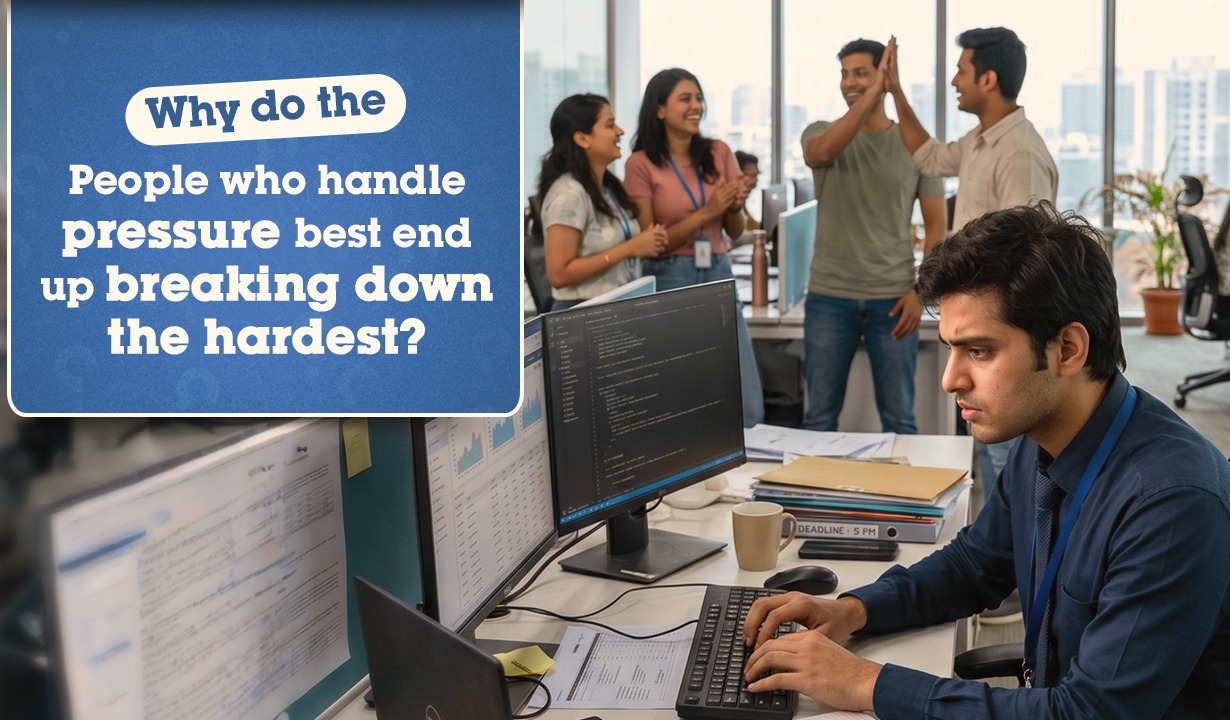
You are the person who always delivers.
Deadlines don't scare you.
Pressure sharpens you.
You're the one who figures it out.
Who stays when it matters.
Who never lets the team down.
So why, on one completely ordinary Tuesday, does getting out of bed feel impossible?
Why does the project you used to love feel like a weight you're dragging?
Why does praise land hollow?
Why are you mentally exhausted from work, in a way that a week off doesn't fix?
This is not just burnout from overworking the way most people picture it.
This is more specific.
More psychological.
More invisible.
This is what happens when a high performer's internal system runs out of road.
Let me say something most people won't.
Performance is a behaviour.
Learnable. Repeatable. Measurable.
But the psychology driving relentless high performance is something different.
For a significant number of overachievers, that psychology is not rooted in passion.
It is rooted in fear.
Fear of being seen as ordinary.
Fear of what happens to your identity when the results stop.
Fear that without the performance, there is no version of you that is worth anything.
This is contingent self-worth.
Your value as a person is entirely dependent on your output.
It is extraordinarily common among high performers in Indian workplaces, where pressure and stress at work often become normalized early in life.
The performance keeps going.
The person underneath gets quieter.
Until one day, the person stops responding entirely.
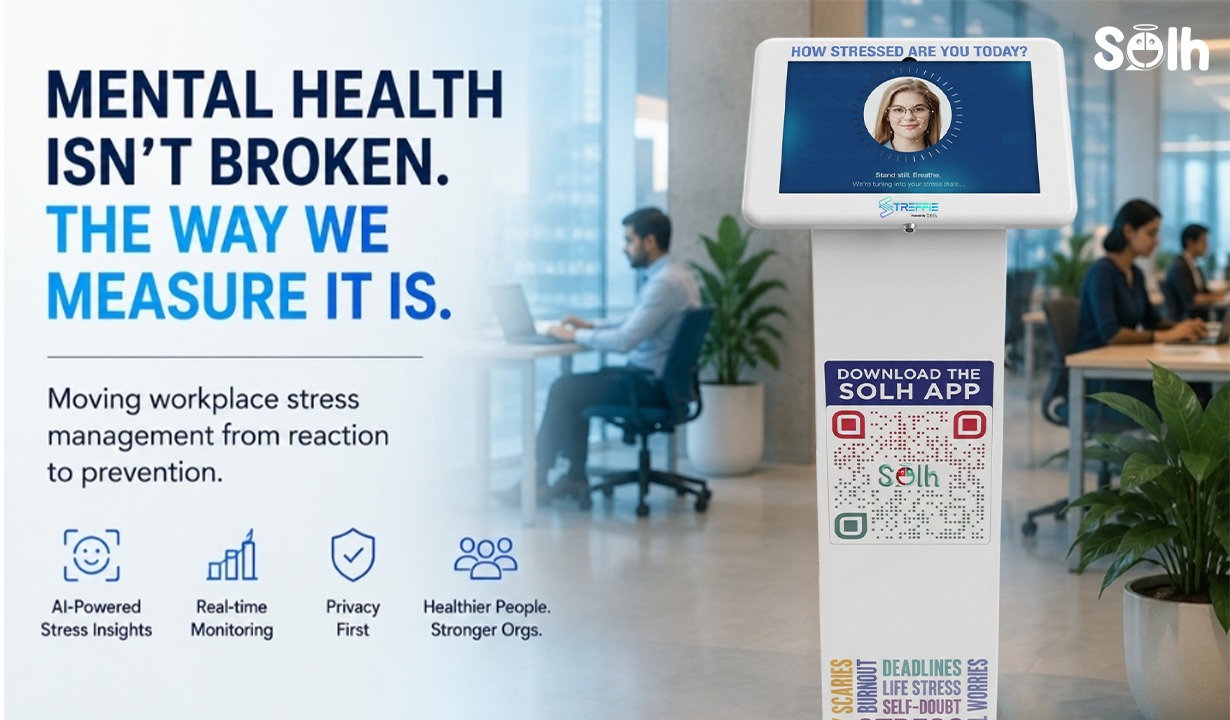
💡 High performers are the least likely to notice their own stress building. Streffie on the Solh app gives you an objective stress score in seconds, bypassing the self-assessment blind spot entirely. Download the app.
Here's the brutal irony.
The qualities that make someone a high performer are the exact qualities that make burnout at work hardest to catch.
High performers have spent years training themselves to override discomfort.
Push through tiredness.
Push through self-doubt.
Push through resistance.
That override mechanism does not distinguish between
"I'm tired and need to push through this deadline" and
"I'm burning out and need to stop."
It just overrides.
The result?
Mentally exhausted from work.
Functionally performing.
Scoring well on every metric others can see.
While every internal metric quietly collapses.
48% of Indian corporate employees are already at high risk for poor mental health.
But within that number, high performers are disproportionately invisible.
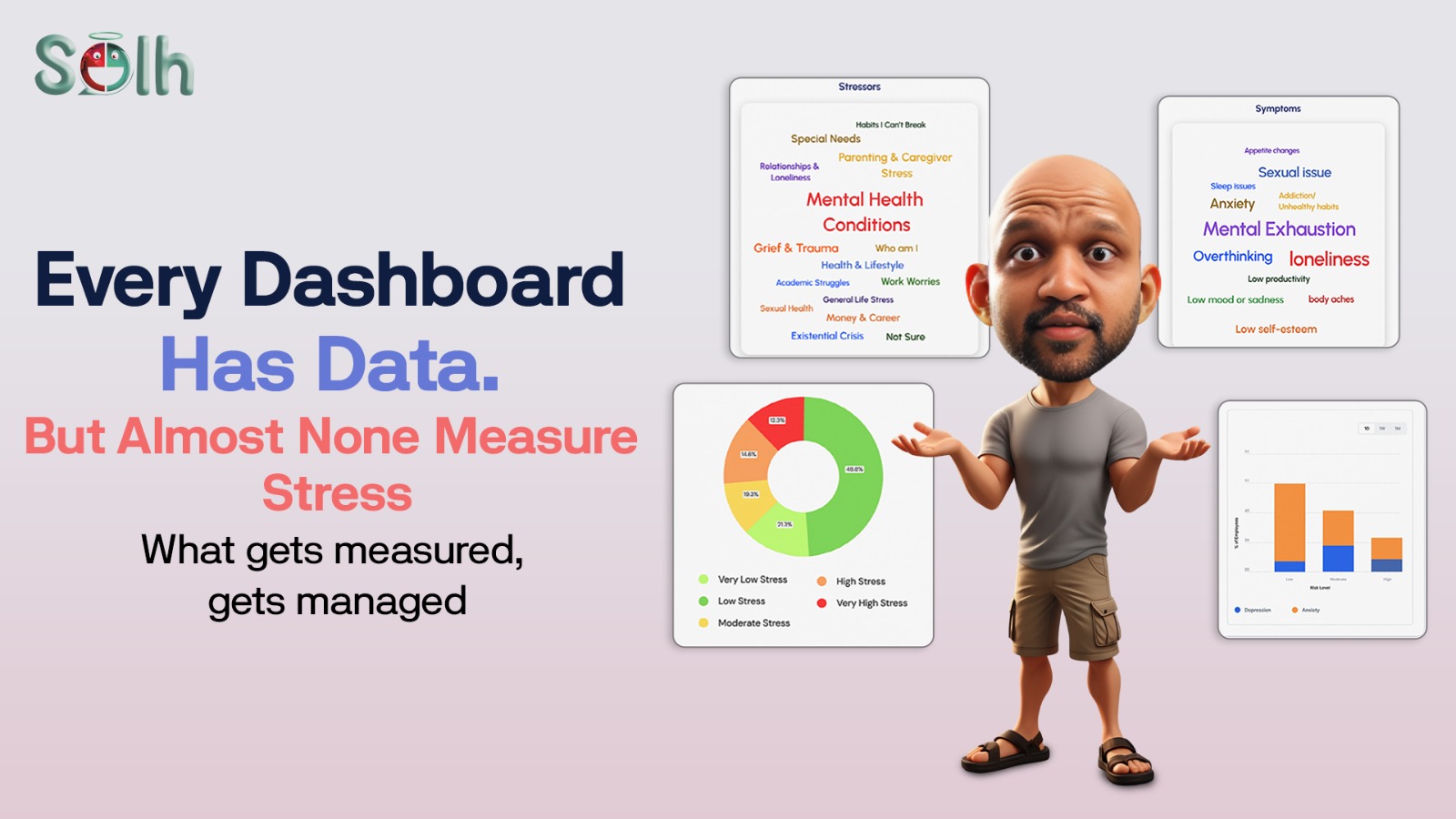
Because the tools organisations use to detect wellbeing problems rely on self-reporting and high performers rarely admit when they are overwhelmed or struggling with stress and pressure at work.
The crash looks sudden to everyone watching.
It was not sudden.
It was a long time coming.
Hidden behind excellent quarterly numbers.
Three psychological patterns. All roads lead to the same destination.
The impossibility of enough.
There is no threshold at which a high performer feels they have done enough.
The promotion arrives and immediately becomes the baseline.
The award is filed away.
The successful project closes and the next one begins before the first was processed.
No internal signal that says "you can relax now."
Only the next thing.
Stress as identity.
Many high performers have been under pressure so long they've built their identity around it.
Being stressed.
Being needed.
Being indispensable.
These become markers of worth rather than warning signs.
Remove the pressure on a holiday, during a slow week and instead of relief, many high performers feel anxiety.
Because without the pressure, they don't know who they are or how to handle pressure at work in a healthier way.
Emotional suppression as strategy.
High performers, especially in Indian corporate environments, have learned that emotional expression is a professional liability.
You don't show the feedback stung.
You don't admit you're overwhelmed.
You recalibrate. You adapt. You move on.
Effective short-term.
One of the most reliable predictors of breakdown long-term.
The emotions don't disappear because they aren't expressed.
They accumulate.
India makes all of this harder.
Being a high performer here is rarely just professional.
It carries family weight.
Community weight.
The pressure to perform is not just internal.
It is relational. Social. Generational.
90% of India's workforce under 25 experiences anxiety daily.
These are not people who entered the workforce burned out.
These are people who have been in performance mode since their board exams — constantly navigating pressure and stress at work even before entering corporate life.
By the time they hit their late twenties and the crash comes, it is not a single event.
It is a decade of running on contingent self-worth, emotional suppression, and the deep cultural conviction that stopping is failure.
💡 If you're the person who never asks for help, Solh Buddy was built specifically for you. Available 24/7. No judgment. No history required. Start a conversation on the Solh app.
High performer burnout does not respond to rest alone.
A holiday helps.
A week off helps.
But if the psychological patterns driving the burnout remain intact, recovery is temporary.
Most high performers are back at the same pace within two weeks of returning — still struggling with how to handle stress and pressure at work effectively.
Because the internal architecture that created the burnout hasn't changed.
What actually shifts things is a combination of two things high performers are structurally resistant to.
Self-awareness without judgment.
An honest read of your internal state without immediately converting it into a problem to solve or a weakness to hide.
Support without agenda.
Access to something that will not use your vulnerability against you.Not connected to your performance review.
Not visible to your manager.
Not threatening to the confidence your team has in you.
For most high performers in Indian organisations, that space does not exist.
Here's the most counterintuitive truth about overachiever burnout.
The most dangerous phase is not when performance drops.
It is when performance is still high and everything inside is quietly coming apart.
Because that is when no one intervenes.
No flag is raised.
The person most in need of support is the last person anyone checks on.
62% of Indian employees report burnout at three times the global average.
The high performers in that number are not the ones visibly struggling.
They are the ones still delivering.
Still smiling in the team meeting.
Still sending responses at 11pm.
They crash hardest because they held on longest a classic case of burnout from overworking masked by consistent performance.
Solh was built with this person in mind.
Streffie doesn't ask how you're feeling.
It reads your stress biomarkers objectively.
68 micro-expressions.
Up to 90% accuracy.
A score that isn't filtered through your highly trained capacity to say "I'm fine."
Solh Buddy is there for the moments the performance is still on but the person underneath is running on empty.
24/7.
Complete privacy.
No performance consequence.
📲 Talk to Solh Buddy — built for the people who never ask for help.
High performance and personal wellbeing are not a trade-off. They never should have been.
Frequently Asked Questions
1. What is burnout from overworking?
Burnout from overworking is a state of physical, mental, and emotional exhaustion caused by prolonged stress and excessive workload. It often goes unnoticed in high performers because they continue to function despite feeling drained internally.
2. Why do high performers feel mentally exhausted from work?
High performers often push through stress without acknowledging it. Over time, this leads to being mentally exhausted from work, as emotional and psychological fatigue builds up beneath consistent performance.
3. How can managers handle pressure and stress at work?
Learning how to handle pressure at work starts with recognizing limits, setting boundaries, and not tying self-worth only to performance. Regular breaks, self-awareness, and seeking support are key to managing stress effectively.
4. What are the early signs of burnout at work?
Early signs of burnout at work include constant fatigue, lack of motivation, emotional detachment, reduced satisfaction from achievements, and feeling overwhelmed even with routine tasks.
5. How can Solh Wellness help with burnout from overworking?
Solh Wellness offers tools like Streffie to measure stress levels objectively and Solh Buddy for 24/7 emotional support. It helps individuals who are mentally exhausted from work manage pressure and stress at work in a safe, private, and judgment-free space.