

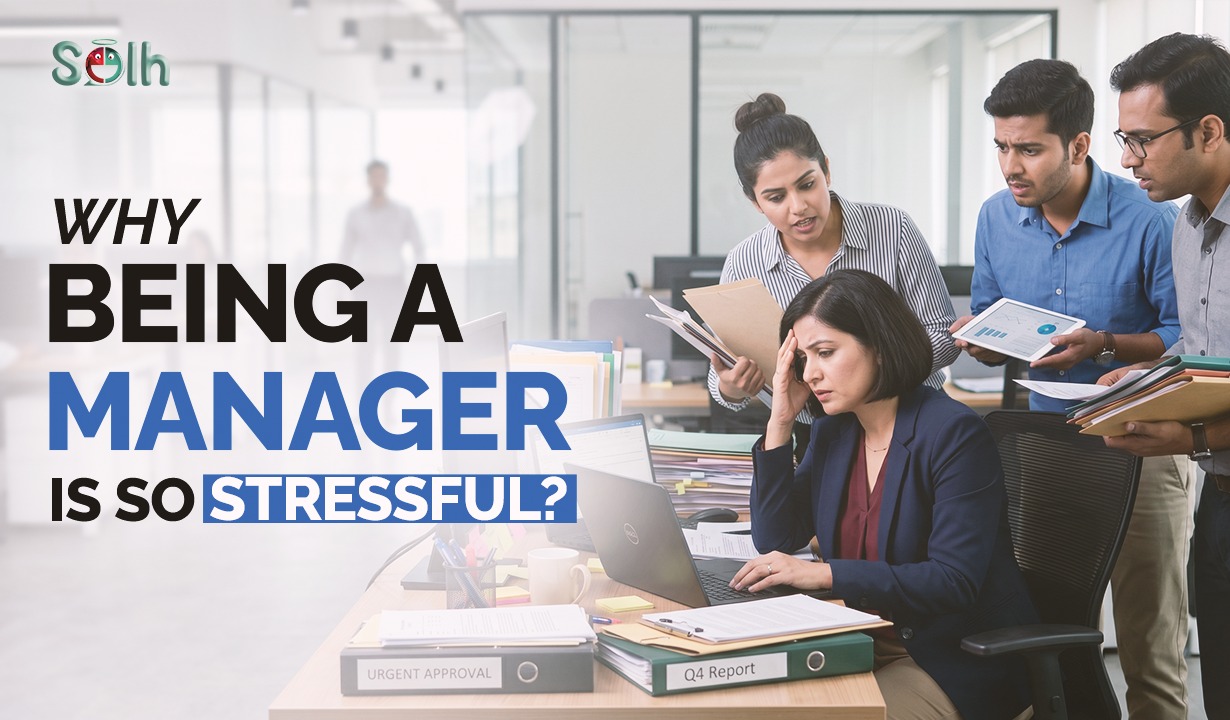
There's a particular kind of exhaustion that hits on Sunday evenings. Not the kind that comes from running a marathon or pulling an all-nighter. It's quieter than that a low-grade dread about the week ahead. The performance review you need to deliver. The team member who's been disengaged. The skip-level meeting where you'll be asked why your team's numbers slipped, even though you spent half the week managing a conflict that never made it into any report.
If this sounds familiar, you're probably a people manager.
And nobody warned you it would feel like this.
The Job Inside the Job
Here's what the job description said: Lead a team. Drive results. Develop talent.
Here's what the job description didn't say: Absorb everyone's anxiety. Be the buffer between leadership pressure and team reality. Make ten micro-decisions a day that affect people's careers, confidence, and mental health at work and then go home and pretend you're fine.
Managing people is stressful in a way that's structurally invisible. Unlike individual contributors, whose stress is largely tied to their own workload and deadlines, a people manager carries multiplied stress - their own deliverables, plus the emotional and professional weight of every person on their team.
This is what we call the Manager Tax. It's the invisible cost of being responsible for people, not just outcomes.
💡 Not sure how much of this tax you're currently paying? Solh's Streffie gives you an objective stress score in seconds - no questionnaires, no wearables, just your phone camera. Download the Solh app and check your score today.
Why Being a Manager Is Stressful in Ways the Data Confirms
This isn't anecdotal. In India, 62% of employees report burnout three times the global average of 20%. And yet the people least likely to acknowledge it, least likely to seek help, and most likely to keep absorbing everyone else's pressure are the managers themselves.
The private sector is particularly exposed 42% of employees in private sector organisations report depression and anxiety. The people managing those employees are carrying that reality every single day, often without any support structure of their own.
And the cost of ignoring it? 49% of professionals want to quit their jobs due to work stress. When a manager burns out and leaves, it isn't just one vacancy it's an entire team destabilised.
Manager burnout doesn't just affect one person. It destabilises entire teams, quietly and quickly.
The bitter irony? The more empathetic and capable you are as a manager, the more stress you absorb.
The Three Invisible Stressors Nobody Talks About
Workplace stress for managers doesn't usually look like burnout at first. It looks like three things hiding in plain sight:
1. Emotional Labour Without a Container
When a team member comes to you in distress about workload, a personal crisis, a conflict with a colleague — you listen, you support, you problem-solve. You're effectively providing emotional labour at work. But no one provides that same container for you. There's no one above you who says, "Hey, how are you actually doing?"
This accumulation of unprocessed emotional weight is one of the most underrecognised causes of manager burnout.
2. Role Ambiguity in Both Directions
You're not senior enough to set strategy. You're not junior enough to just execute. You're the person translating leadership vision into daily reality often with incomplete information, shifting priorities, and a team that needs certainty you don't have. This dual ambiguity being pulled from above and below simultaneously is a chronic stressor that rarely resolves itself.
3. The Accountability Gap
You're accountable for your team's performance. But you often don't control the variables that determine it hiring decisions, resource allocation, tooling, organisational culture. Being responsible for outcomes you can't fully control is, neurologically speaking, a recipe for chronic stress. It activates the same threat-response circuits that our brains use for physical danger except this danger never fully resolves.
The Overwhelmed Manager Is Not a Weak Manager
Let's say this clearly: if you're overwhelmed as a manager, that is not a character flaw.
The systems most organisations have built were designed around individual performance appraisals, KRAs, targets. They were not designed to support the people managing those systems. Employee Assistance Programmes (EAPs), where they exist, see less than 2% utilisation largely because they're generic, reactive, and carry a stigma that managers, who are supposed to be strong, simply cannot afford to be associated with.
This is the structural problem. And it has a structural cost.
When a manager burns out, the impact doesn't stay contained to one person. Engagement drops across the entire team. Attrition goes up. Productivity declines across a whole unit. The people who were depending on that manager for direction, feedback, and psychological safety they feel it too, often before the manager even realises what's happening.
The manager is the multiplier. Which means manager burnout is also a multiplier.
💡 If you're reading this and recognising yourself that recognition is worth acting on. Solh Buddy is your 24/7 support companion, built for the person who's always the support system for everyone else. Start a conversation on the Solh app no waiting rooms, no judgment.
What Dealing with Stress as a Manager Actually Requires
Most advice for stressed managers is well-intentioned and largely useless. "Set better boundaries." "Delegate more." "Practice self-care." None of that addresses the structural reality of why being a manager is stressful in the first place.
How to deal with stress as a manager looks very different from generic wellness advice. What actually helps is:
Visibility into your own stress patterns, not just your team's. Most managers are so focused on monitoring their team's wellbeing that they have zero data on their own. Knowing when you are approaching the edge before you hit it is the single most powerful intervention available.
A space that is genuinely yours where you're not the support person, not the decision-maker, not the leader. A space where you can process what you've absorbed without judgment and without it affecting how anyone at work perceives you.
Tools that don't require you to admit weakness to your organisation. The reason managers don't use EAPs is because EAP usage is visible. Anonymous, accessible, on-demand support changes that equation entirely.
The Question Worth Asking
When did you last check in with yourself the way you check in with your team?
Not a casual "I'm fine" in your head. An actual, honest read of where you are — your stress levels, your emotional bandwidth, your capacity for the week ahead.
For most managers, the answer is: not recently. And often: never.
That gap between the support managers give and the support they receive is exactly where the Manager Tax compounds silently, until it becomes something much harder to recover from.
You Carry Enough. You Shouldn't Have to Carry It Alone.
Solh is built for exactly this: the person who's responsible for everyone else and has quietly stopped being responsible for themselves.
The Solh app includes Streffie , an AI-powered stress monitoring tool that gives you an objective stress score in seconds using just your phone camera, no wearables required. It's not a mood diary. It's not a questionnaire. It analyses 68 facial micro-expressions with up to 90% accuracy, giving you a real-time read of where you actually are not where you think you are.
And when the score shows what you already suspected - that you're not fine Solh Buddy is there. Your 24/7 support companion, built to listen without judgment, guide without agenda, and connect you to the right support when you need it.
Frequently Asked Questions (FAQs)
1. Why is being a people manager considered one of the most stressful roles?
Because managers carry double the burden their own workload plus the emotional weight of every person on their team. This invisible pressure rarely shows up in any report but quietly drains even the most capable leaders.
2. How does manager burnout impact team performance?
One burned-out manager can destabilise an entire department. Engagement drops, attrition rises, and productivity declines making manager wellbeing a business-critical priority, not just a wellness checkbox.
3. Why do managers rarely ask for help even when overwhelmed?
Because seeking help feels like admitting weakness. Traditional EAPs carry stigma and visibility risks that managers simply can't afford which is why less than 2% of employees actually use them.
4. What can HR leaders do to support managers before burnout sets in?
Stop waiting for managers to break down before offering support. Proactive, anonymous, AI-powered tools can detect rising stress early - before it starts showing up in performance numbers.
5. How is Solh different from a traditional EAP?
Solh is anonymous, always available, and built around early detection - not reactive crisis support. Managers can check their stress score privately in seconds, without raising their hand to anyone in the organisation.