
Why do modern systems create more stress?
Modern workplaces are designed around speed, responsiveness, and availability, which directly contributes to stress from fast work environments.
- Faster decisions
- Shorter timelines
- Immediate replies
- Continuous updates
These systems reward velocity.
They create system driven stress by prioritising output speed over human regulation.
But the human nervous system does not regulate at the same pace.
It needs completion signals.
It needs predictable pauses.
It needs downshifts after effort.
When work systems remove those, stress caused by work systems becomes continuous.
What happens when stress has no end point?
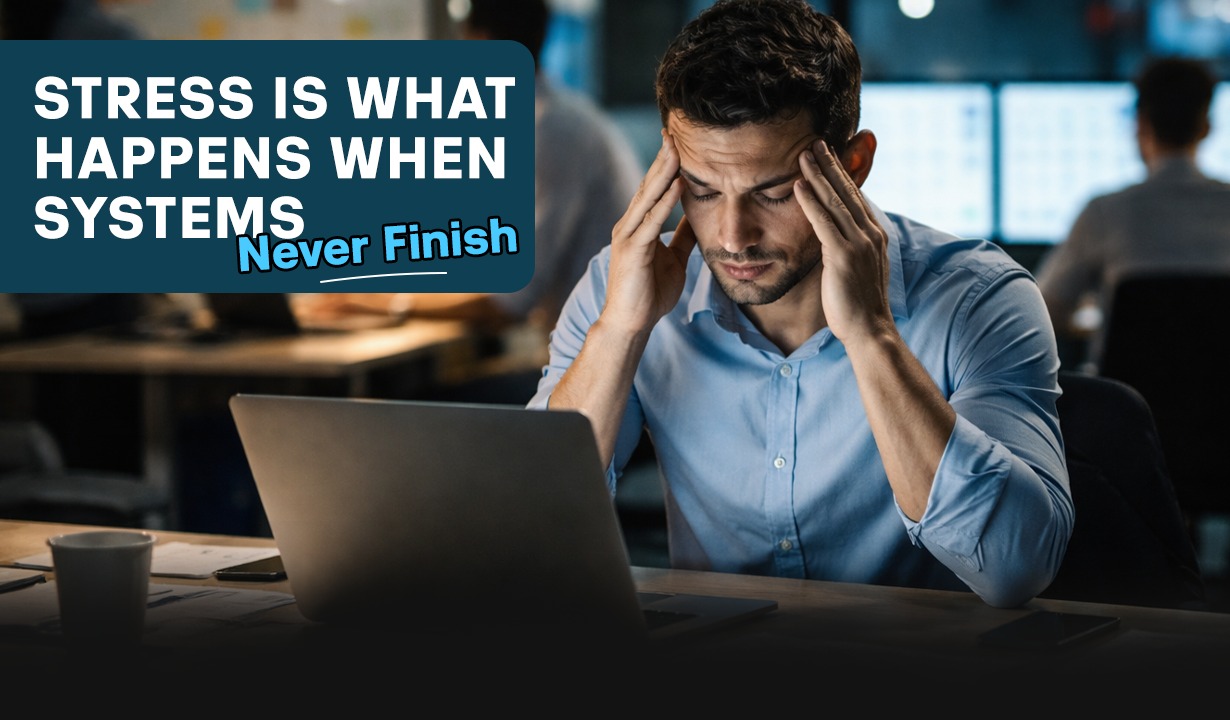
Stress is meant to rise and fall.
In always-on work culture stress, it never falls.
When it doesn’t fall:
- The body stays alert
- The mind stays scanning
- Emotions stay guarded
People don’t feel stressed immediately.
They feel:
- Restless
- Hyper-focused
- mentally busy
This is not calm.
This is extended activation.
In systemic stress in organizations, extended activation is normalised as productivity.
Over time, extended activation turns into depletion.
Why don’t people notice this early?
Because output doesn’t drop at first.
In fact, output often increases.
Speed masks strain in modern workplace stress.
People answer faster.
They multitask better.
They push through.
But internally, recovery keeps shrinking.
Stress caused by work systems does not show up in performance metrics.
It shows up as nervous system load.
Why “individual stress management” fails here
When stress is system-driven, individual solutions fall short.
You can teach breathing.
You can offer meditation.
But if:
- deadlines keep stacking
- urgency never reduces
- decisions never settle
The nervous system never receives safety cues.
In system driven stress, personal tools are forced to fight system design.
Stress management must match system design, not oppose it.
What actually needs to change?
Not motivation.
Not discipline.
But:
- Pacing
- Closure
- recovery windows
In stress from fast work environments, stress reduces only when systems allow regulation.
The Solh perspective
Solh treats stress as an environmental signal, not a personal flaw.
That’s why stress monitoring , guided recovery, and continuous awareness matter.
You can’t fix speed-induced stress with willpower.
Founder’s Reflection
We didn’t suddenly become fragile.
We built systems that forgot humans need to slow down to stay well.
FAQ’S
1. What is stress caused by work systems?
Stress caused by work systems occurs when organisational design prioritizes speed, urgency, and constant availability without allowing the nervous system time to regulate. The stress comes from how work is structured, not from individual capacity or effort.
2. Why does modern workplace stress increase even when performance improves?
Modern workplace stress often rises alongside performance because speed masks strain. People respond faster and push harder, while recovery quietly disappears. The nervous system carries the load long before output drops.
3. How do fast work environments affect the nervous system?
Stress from fast work environments keeps the nervous system in extended activation. Without clear pauses, completion signals, or downshifts, stress doesn’t resolve — it accumulates.
4. Why doesn’t individual stress management work in system driven stress?
In system driven stress, individual tools like meditation or breathing can’t fully help because the source of stress remains active. When urgency, deadlines, and decisions never settle, the nervous system doesn’t receive safety cues.
5. What actually reduces stress caused by work systems?
Stress reduces when systems allow pacing, closure, and recovery windows. When work is designed to complete instead of stay permanently open-ended, regulation naturally returns.
6. How does Solh Wellness help with system-driven stress?
Solh Wellness helps track stress, guide recovery, and restore nervous system balance, so fast work environments don’t keep you in constant activation.