
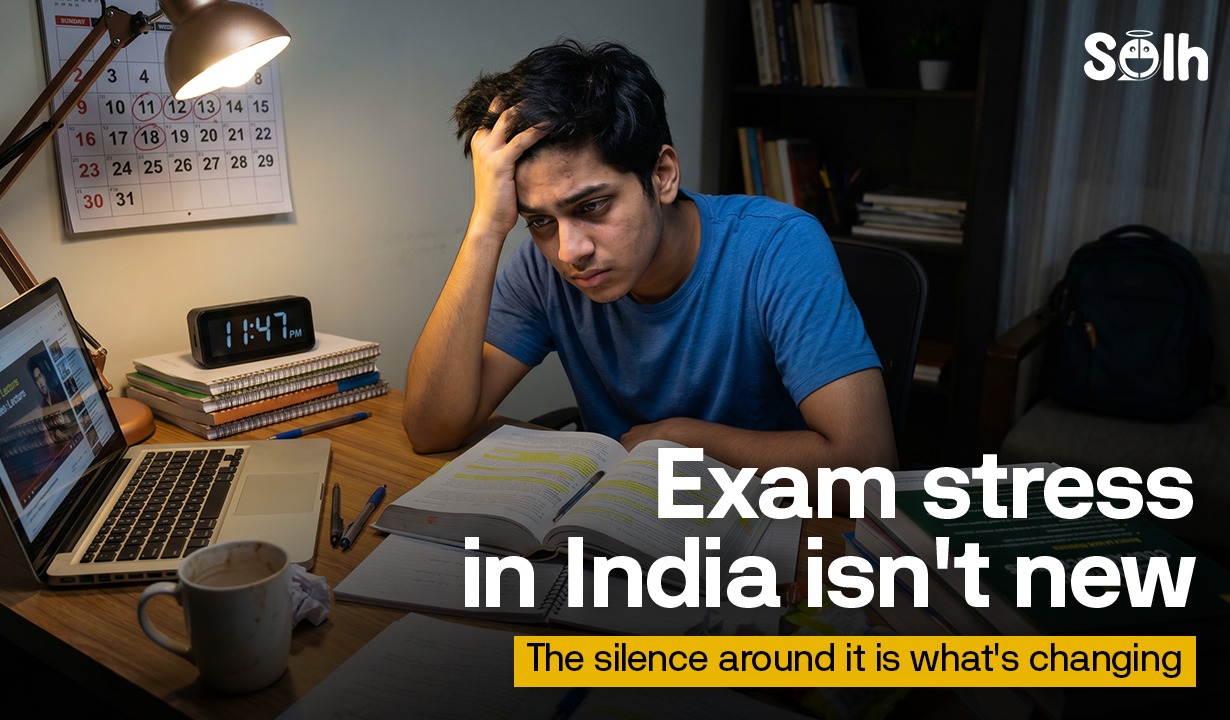
You call home. Your mother asks how the mock went.
You say it was fine.
It was not fine. Section two went blank somewhere in the middle. Not tired-blank. The kind of blank that happens when a mind has been running on four hours of sleep and the dread of what happens if you don't make it. You can't explain that to someone who hasn't sat in that hall.
So you say: fine.
You've been saying fine for eight months.
This isn't a story about JEE or NEET results. It's about what's happening inside students right now, during the preparation, before any result arrives. What's building in the silence between the study hours and the phone calls home.
The exam stress we've decided is normal
India has built something unusual. A culture where student stress is not just accepted. It is expected.
"Padhna hai toh takleef toh hogi."
That sentence has been repeated across so many generations that it's stopped sounding like an opinion. It sounds like gravity now. Something you accept and move on from.
But there's a real difference between pressure that sharpens focus and chronic stress that slowly hollows a person out. For a lot of India's JEE and NEET aspirants, what they're living through is the second kind. And the system around them has almost no language for that distinction.
What the numbers say
India recorded 14,488 student suicides in 2024, roughly 40 every single day.
In Kota, 17 students died by suicide that same year. In the first 22 days of January 2025, six more were gone.
A 2025 study across 1,628 students in eight major Indian cities found that nearly 70% experience moderate to high anxiety and 59.9% show signs of depression during their preparation years. (Indian Journal of Psychiatry, 2025) A separate study on NEET aspirants found that 75.5% experience severe pre-exam stress, with most having no access to any professional support. (Journal of Medical Evidence, 2024)
Among students who reached the point of suicidal thoughts, fewer than four in ten told anyone. Most told a friend. Not a counsellor. Not a parent. (NIMHANS survey, 2024)
These numbers aren't describing edge cases. They're describing the average student inside a competitive exam pipeline. For many, the stress has become the whole experience.
What two years of preparation actually costs
A 2023 Lokniti-CSDS study in Kota found that over 85% of students spend six to seven hours daily inside coaching institutes, some pushing to eight, on top of self-study. More than 80% said they wanted a single day off each week.
Not a vacation. One day.
Students reported loneliness they couldn't explain. Mood swings with no obvious cause. Exhaustion that sleep wasn't fixing. Going to bed later every night and waking up more depleted every morning.
Now add everything else on top: leaving home at 15 for the first time, living in a hostel room with three people you don't know, watching your batchmate rank higher in the weekly test, knowing your parents refinanced something to get you here, carrying the weight of every relative who introduced you as "the one going for IIT."
In JEE Advanced 2025, 1,80,422 candidates appeared. 54,378 qualified. Roughly 70% of students who gave two to three years of their lives didn't get through. The only word the system has for that is: didn't clear.
In NEET 2025, 22.09 lakh students appeared. 12.37 lakh cleared. Nearly 10 lakh teenagers were told their dream didn't make the cut this year.
There's no language offered for what that does to a mind still forming.
Four things exam stress does that nobody names
Rank becomes the whole identity
When a student spends two to three years doing nothing but preparing for one exam, their sense of self folds into it completely. A bad mock score stops feeling like a setback. It feels like a verdict. Gradually, students stop thinking of themselves as people who love science. They become their potential rank. When that rank disappoints, there's nothing underneath it to land on.
Emotions learn to disappear
Coaching environments penalize showing struggle. Saying "I'm not okay" reads as evidence you're not cut out for this. Students learn to absorb everything without expression. The feelings don't go anywhere, though. They come out later as physical symptoms, as irritability, as complete shutdown in the weeks before the exam. Research on student emotional health consistently shows that suppressed stress doesn't resolve — it accumulates.
Sleep breaks, and from there everything else follows
Late study hours plus performance anxiety destroy sleep faster than almost anything else. Once sleep goes, so does memory consolidation, emotional regulation, and the ability to think clearly under pressure. The student studies harder to compensate. The cycle tightens.
Family love turns into a weight the student can't set down
Most JEE and NEET students come from families where real sacrifices were made. The student knows this in detail: the loan, the thing that was delayed, the relative who was called. The fear of not performing isn't just personal anymore. It's the fear of failing the people who gave something up for you. That weight doesn't lift when the books open. It sits on the desk alongside them.
Why students don't say anything
Here's the part that makes this hard to address.
Most students know they're struggling. They're just certain that saying so will make everything worse.
Showing stress in a coaching environment reads as weakness, as not being serious. Parents who love their children genuinely, who would sacrifice almost anything for them, often can't see that their anxiety about results has quietly closed off the space for their child to be honest. And so the student keeps going. Carries it alone. Tells themselves it'll get better after the exam.
Sometimes it does. Sometimes it doesn't. By the time anyone notices, a lot of damage has already happened quietly.
Among students who had suicidal thoughts, only 38.1% told someone. That number isn't about a lack of love. It's about an environment where saying "I am not okay" has real consequences, and staying silent feels like the safer choice.
What students actually need
This isn't an argument for studying less. The entrance system is what it is, and students have to get through it. The question is whether they do it with real support, or alone.
Catching stress before it becomes a crisis matters. Most students can't tell when their exam anxiety has crossed from manageable into dangerous. Regular, low-barrier check-ins catch warning signals before they compound into something much harder to recover from.
Something available at 11 PM in a hostel room matters. The hardest moments don't happen during school hours. They happen on a quiet Tuesday night after a bad mock result, when there's no one to call and the anxiety is loud. Students need support that's actually there when the pressure peaks, not something with office hours.
Adults who create safety matter. The people around students need to understand what academic pressure looks like in practice and, more than that, what it needs from them. Not a lecture about focus. A space where the student can say "main theek nahi hoon" without it becoming a conversation about preparation.
A sense of self that isn't stored inside one exam matters. Students need consistent reminding that they are more than their score. This sounds obvious. For a student who has spent three years being evaluated primarily by rank, it genuinely isn't.
How Solh supports students under exam stress
Solh is built for the student who is not fine but has been saying fine for months.
Most students won't fill out a form or admit out loud that they're struggling. Streffie reads stress through facial cues in an under-10-second scan using just a phone camera. No questions. No judgment. It gives a student an honest read of where they actually are, without requiring them to explain anything to anyone.
Beyond detection, Solh builds personalized recovery paths specific to what that student is experiencing. A student scared of disappointing their parents needs different support than one stuck in performance paralysis, who needs different support than one dealing with isolation. The plans include breathing techniques, sleep tools, focus practices, and emotional regulation exercises that fit around a study schedule.
Solh Buddy is available at any point in the night. For students who can't yet open up to another person, it's a low-barrier first step that listens without judgment and carries no performance consequence.
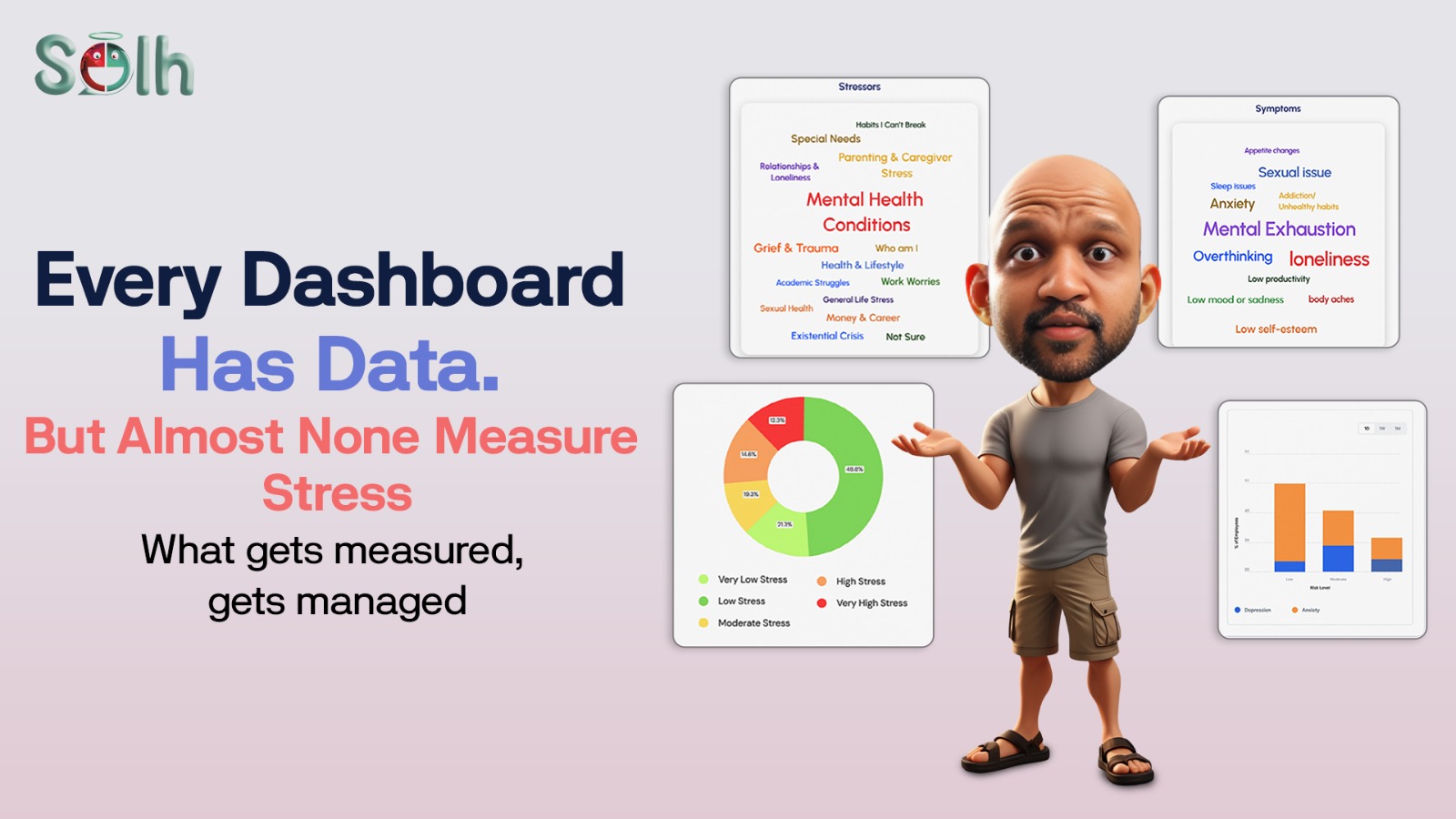
For coaching institutes, universities, and schools, Solh's Smart Dashboard gives administrators real-time, anonymized wellbeing data across their student population. The goal is to act before someone reaches a breaking point, not after.
Solh works with institutions including Physics Wala, Parul University, Thapar Institute, and GD Goenka.
To every student reading this
You are not your rank. You never were.
We know what these months have cost. The sleep that didn't happen. The phone calls home where you said fine. The mock tests you were scared to open. The weight of every person counting on you who doesn't fully understand what that weight feels like from your side.
Struggling under this much pressure doesn't mean you're not strong enough. It means you're carrying something real. Most adults around you have forgotten how heavy it actually is.
Please talk to someone. Please ask for help. Don't carry this alone.
To parents reading this
Your child doesn't need a perfect result from you right now.
They need to know your love isn't sitting inside a merit list. The most useful thing you can do isn't reviewing their study schedule. It's making home the kind of place where they can say "main theek nahi hoon," and where they believe you'll actually listen.
For a lot of students, that safety is what makes performance possible at all.
Frequently asked questions
How does competitive exam preparation affect a student's mental health?
JEE and NEET preparation puts sustained pressure on adolescents during the years when identity is still forming. Studies show over 70% experience moderate to high anxiety and nearly 60% show signs of depression. The impact isn't only academic. It shapes how students see their own worth, sometimes for years after the exam is done.
What are the warning signs that a student is struggling beyond normal exam stress?
Watch for withdrawal from family and friends. Sleep changes in either direction. Loss of interest in things they used to enjoy. Statements like "I'm useless" or "what's the point." Unexplained physical complaints. Seeming emotionally flat even when things are going reasonably. Several of these, persisting over weeks, needs a real response.
Why don't students ask for help even when they're clearly struggling?
The environment penalizes it. Showing stress reads as weakness. Many students also don't want to worry parents who've already sacrificed for them. And in most coaching environments, there's no trusted person to talk to. Solh addresses this with a private space where students can access support without feeling like a burden.
What should parents do if their child is under extreme exam stress?
Listen without jumping to solutions. Don't make the first conversation about performance. Ask how they're feeling, not how they're studying. If signs are serious or ongoing, bring in professional support sooner rather than later.
Does managing stress actually improve exam performance?
Yes, consistently. Chronic stress impairs memory consolidation, disrupts sleep, and reduces the ability to think under pressure — all of which affect exam performance directly. Students who manage their stress retain information more effectively and hold up better when it counts.
How does Solh help students dealing with exam stress?
Solh provides AI-powered stress detection through Streffie, personalized recovery plans, 24/7 support through Solh Buddy, and over 1,000 expert-reviewed resources. For institutions, the Smart Dashboard enables early identification of at-risk students before things become a crisis.
Can schools and coaching institutes integrate Solh?
Yes. Solh partners with schools, universities, and coaching centres across India. Institutions can request a demo at solhapp.com/contact.php.
Is it too late if the exam is a few weeks away?
No. Even a few weeks of consistent stress management can improve sleep, reduce anxiety, and sharpen focus. There's no ideal moment to start.
What about students turning to substances to cope with exam pressure?
It happens more than most people acknowledge. Prolonged academic stress can push students toward alcohol, nicotine, or other substances as pressure release. If that's become part of the picture, Prarambh Life offers structured de-addiction support built specifically for the Indian context.
If you or someone you know is in distress: iCALL: 9152987821 | AASRA: 9820466627
Download the Solh App on iOS and Android. For institutions: Request a Demo