
It happens at roughly the same time every day.
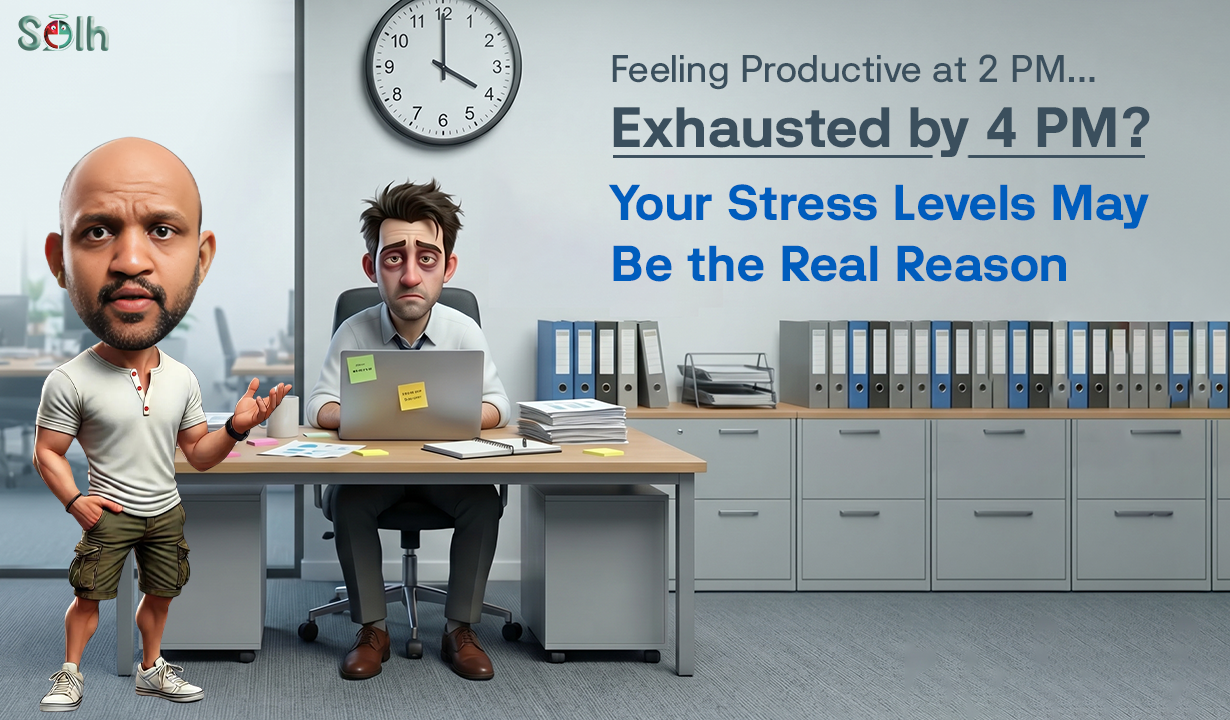
Morning momentum is gone. Somewhere between 3pm and 5pm, everything becomes harder. The email that should take ten minutes takes thirty. The decision feels disproportionately heavy. Eyes are dry. Concentration keeps slipping. You're physically at work. Your brain handed in its notice an hour ago.
You manage it with another coffee. Or you push through and produce half of what you would have in the morning. Or you check your phone for fifteen minutes, feel vaguely guilty, and try to re-engage.
The 4pm wall is not a personal failing. It is biology. What many people call the afternoon slump is a natural part of the body's rhythm, but it is biology that chronic stress makes dramatically worse.
Why Your Body Is Designed to Crash in the Afternoon
Your body runs on a circadian rhythm. A roughly 24-hour internal clock. Regulating alertness, hormone production, body temperature, energy availability.
Within that cycle, there is a predictable afternoon dip. The period between roughly 1pm and 4pm is a biologically challenging window for most people and often explains the familiar mid afternoon slump many professionals experience. The circadian rhythm naturally produces a trough in alertness and metabolic energy.
This is not caused by lunch. It is a built-in feature of human biology. Observed across cultures and time zones. In people who eat lunch and people who skip it.
In a world built around this biology, early afternoon would be reserved for lower-cognitive work, rest, or movement.
In the Indian corporate world, it is typically when back-to-back meetings resume. Cross-timezone calls happen. The pressure of the afternoon deliverable list starts to mount.
💡 Wondering whether your 4pm slump is pure biology or stress-amplified? Streffie on the Solh app tracks your stress score across the day so you can see the pattern in real numbers. Download and start tracking.
How Chronic Stress Turns a Manageable Dip Into a Full Crash
The circadian dip is manageable under normal conditions. Most people can navigate it with a short break, some movement, a shift to lower-cognitive tasks.
The problem is that for most Indian professionals, the afternoon dip is not hitting a rested, regulated nervous system. It is hitting one that has been running on cortisol since 8am.
Here's the physiology nobody explains at work.
Under healthy conditions, cortisol peaks in the morning and progressively declines through the day. Under chronic stress, this rhythm flattens. The morning peak that should energise you is blunted. The afternoon decline that is already a biological low point becomes dramatically deeper.
The result is an afternoon crash that is not just a circadian dip. For many professionals, this persistent afternoon tiredness is a sign of an overworked stress system. It is a cortisol-depleted, neurologically fatigued system hitting its biological floor. In the middle of the workday. With three more hours of expected productivity ahead of it.
The data makes the scale of this visible.
Nearly 60% of Indian urban professionals average barely six hours of sleep per night. Poor sleep translates into an average productivity loss of 11.3 days per year per employee , costing companies approximately ₹2.1 lakh annually per person. 46% of Indians are still getting less than six hours of uninterrupted sleep daily. 50% of Indian professionals say stress directly reduces their productivity.
These are not separate problems. They are the same system failing at the same time. The afternoon is simply when the failure becomes impossible to ignore, turning a normal dip into a much deeper afternoon slump.
The Ultradian Debt Nobody Is Talking About
Beyond the 24-hour cycle, your body operates on ultradian rhythms. Cycles of roughly 90 to 120 minutes. Governing shorter waves of high focus and necessary rest within the working day.
At the end of each ultradian cycle, your brain sends signals asking for a brief recovery period.
Difficulty concentrating. Yawning. A sudden urge to check your phone. Restlessness. Mild drowsiness.
Most people interpret these as distractions to be overcome. Push through with caffeine or willpower.
When you override enough of these signals across enough days, the deficit accumulates.
The afternoon crash is often not just the circadian dip. It is the accumulated debt of several ultradian recovery periods that were refused across the morning. Your body is not failing. It is presenting a bill.
Why Caffeine Is Making the Problem Worse
The near-universal response to the afternoon crash is caffeine.
And while caffeine produces temporary alertness by blocking adenosine receptors, it does not address the underlying cortisol depletion or the ultradian deficit. It borrows alertness from later in the day.
The cost of that borrowing is paid at night.
When cortisol should be low and sleep should come easily. But the system is still partially activated from the afternoon's caffeine. The sleep is lighter. Recovery is incomplete. Tomorrow's cortisol curve starts from a slightly lower baseline than today's.
Over weeks and months, this produces a system that is chronically under-recovered. 59% of Indian adults report daytime sleepiness that affects their work performance. Requires increasing caffeine to maintain the same output. Experiences the afternoon crash earlier and more severely with each passing week.
The caffeine is not solving the problem. It is funding it.
What the 4PM Wall Is Actually Telling You
Here's a reframe worth sitting with.
The 4pm wall is not your enemy. It is your body's most honest communication of the day.
By 4pm, the performance mask most Indian professionals wear has been on for eight hours. The professional composure. The managed reactions. The suppressed frustrations. The sustained concentration the morning demands.
By 4pm, the resources available for all of that are genuinely depleted. The crash is the body saying: this is the real level. This is what is left after a full day of performing, managing, producing under pressure.
If you're consistently hitting the wall hard , earlier than you used to, finding it harder to recover from , that is not a productivity problem. That is a stress load problem.
The afternoon is simply when your biology stops having the resources to hide it.
💡 The Solh app lets you track your stress patterns across different times of day so you can see exactly when your system is most depleted. Download and start building your personal stress map.
What Actually Helps at 4PM
Not more caffeine. Not guilt about the phone scroll.
A Genuine 10-Minute Screen Break
Not a coffee queue while checking messages. A genuine disengagement from information input. Even briefly. Allows the prefrontal cortex partial recovery.
Five Minutes of Movement
The body metabolises stress hormones through movement in a way it cannot do while seated. Five minutes. Not a gym session. Just movement.
A Deliberate Task Shift
Move from high cognitive demand to administrative or mechanical tasks during the trough. Work with your biology. Not against it.
Know Your Personal Pattern
Not everyone's trough hits at exactly 4pm. If you're consistently getting tired in the afternoon, understanding your personal energy pattern becomes even more important. Some people crash at 2pm. Some at 3:30pm. Knowing your specific pattern lets you structure demanding work around it. Not into it.
Your Energy Is Not Random. Your Stress Is Not Invisible.
The 4pm wall is one of the most consistent, measurable expressions of how your stress system is functioning.
It is also one of the most ignored. Because it arrives when the workday demands that it be overcome. Not listened to.
Streffie lets you track your stress score at different points across the day. An objective picture of your personal energy and stress rhythm. Not what you think your stress levels are. What they actually are. Mapped across your day. Across the patterns your body has been expressing all along.
When you can see your stress map, you can work with it.
Solh Buddy is there in the moments when the wall hits and the weight of the day needs somewhere to go. Any hour. No agenda. Complete privacy.
📲 Download the Solh app and track your stress patterns across the day.
Understanding your energy is the first step to stopping the daily battle.
Frequently Asked Questions
Why do I always feel tired around 4pm even after a good night's sleep?
The afternoon energy crash is a built-in feature of human circadian biology not a sleep failure. The circadian rhythm produces a natural alertness trough between 1pm and 4pm regardless of how much sleep you get. Under chronic stress, this trough deepens significantly because cortisol rhythm is disrupted.
The morning energising peak blunts and the afternoon decline becomes a full crash. It is biology compounded by stress load.
Does caffeine fix the afternoon energy slump?
Temporarily. Caffeine blocks adenosine receptors and produces short-term alertness, but it doesn't address the underlying cortisol depletion or ultradian recovery debt driving the crash.
Critically, afternoon caffeine delays sleep onset at night, reduces sleep quality, and means tomorrow's energy baseline starts lower than today's. Over weeks, the crash arrives earlier and hits harder. The caffeine addresses the symptom while worsening the root cause.
How does chronic workplace stress make the 4pm wall worse in India?
Chronic psychological stress flattens the natural cortisol curve , blunting the morning peak that should provide energy and deepening the afternoon trough that already represents a biological low.
With nearly 60% of Indian urban professionals averaging under six hours of sleep and 50% reporting stress-driven productivity loss, most Indian professionals' afternoon dip hits an already-depleted system. The result is a crash that feels disproportionate to the workday ,because it is carrying the accumulated weight of weeks of under-recovery.