
If you want to understand a country, don’t look at its GDP.
Look at its emotional wiring.
For the last 12 months, I’ve been moving through India’s boardrooms, campuses, and workplaces — not out of concern, but out of curiosity.
Because chaos doesn’t drain me.
Chaos reveals things.
And India, right now, is an open emotional laboratory — especially when it comes to workplace stress in India and organisational emotional health.
Everywhere I went, people narrated the same story in different dialects:
“I’m overwhelmed.”
“My mind won’t switch off.”
“I’m functioning, but not fine.”
And while most people looked startled by this collective unraveling, I wasn’t surprised.
If anything, the pattern was predictable.
India isn’t collapsing.
India is showing its emotional architecture — the cracks, the overload, the brilliance, the blind spots behind India’s workplace stress crisis.
I am not exhausted by this.
I am fascinated by it.
Because when a country reaches its emotional tipping point, it gives birth to a new kind of leadership, a new kind of workplace, and a new kind of employee emotional resilience.
And 2026 is going to be the year this transformation becomes impossible to ignore.
Here are the five biggest realisations of this year — and how they will reshape employee well-being and stress across Indian organisations in 2026 and beyond.
India Isn’t Stressed — India Is Unregulated
Let’s stop calling this a “stress” problem.
Stress is not the enemy.
Stress is a signal, a message, a biological notification.
In biological terms, stress is not damage — it is information that the nervous system must know how to process.
The real issue?
Our inability to regulate stress — which is the true driver of workplace stress in India and the absence of regulation inside modern workplaces.
Learn about real-time stress monitoring at work and how AI uncovers hidden stress signals .
Across age groups — from 19-year-old university students to 55-year-old senior leaders — one common pattern emerged:
people do not know how to breathe correctly
people do not know how to calm their nervous system
people do not understand emotional overload
people cannot differentiate between anxiety and activation
people have no recovery cycles during the day
people assume feeling overwhelmed is “normal”
India didn’t become more stressed.
India became less regulated.
And workplaces are now paying the price — with falling performance, increased conflict, mood volatility, and unprecedented burnout across Indian organisations.
This shift will directly influence how organisations rethink performance in 2026 as emotional regulation at work begins to replace motivation as the core performance lever.
2026 will only belong to organisations that prioritise regulation literacy over “stress awareness workshops.”
Burnout Is No Longer a Career Issue — It’s a Cultural Issue
Burnout is not happening at the top or bottom of the organisation.
Burnout is happening everywhere because burnout in India is not professional — it’s cultural, deeply embedded in workplace stress in India.
- We glorify:
sacrifice
constant availability
emotional suppression
overthinking disguised as responsibility
working through illness
never saying no
leadership without emotional education
This creates a workforce that is always performing but never recovering.
The long-term economic cost of employee stress is now becoming impossible for organisations to ignore.
Explore how stress is costing corporate India ₹1.1 lakh crore annually
By 2026, companies will realise the only sustainable culture is one where emotional capacity is protected, not exploited.
Most Employees Aren’t Struggling With Work — They’re Struggling With Themselves
The biggest insight from thousands of Streffie scans ?
People are not overwhelmed by tasks.
They’re overwhelmed by emotions — a defining trait of stress across Indian organisations and nervous system dysregulation at work.
Employees repeatedly told us:
“I can work. I just can’t handle the pressure.”
“I can think. My mind just doesn’t settle.”
“I know what to do. I just don’t have the bandwidth.”
“I want to focus. My body is in chaos.”
It wasn’t a skill gap.
It wasn’t a performance gap.
It wasn’t a motivation gap.
It was a regulation gap — the silent core of India’s workplace stress problem. emotional regulation at work.
In 2026, the most valuable employees won’t be the most talented —
They will be the most emotionally stable.
And companies will have to build the environment that makes stability possible.
Leaders Are Not Failing Because They Lack Strategy — They’re Failing Because They Lack Nervous System Stability
This one is uncomfortable, but necessary:
Leadership breakdowns in 2025 were largely emotional, not intellectual — a direct outcome of unmanaged stress at work in India.
I met founders who understood business perfectly but couldn’t regulate their frustration.
Managers who knew what needed to be done but couldn’t communicate without emotional leakage.
Teams who knew the goal but couldn’t stay aligned because the emotional climate was unstable.
We don’t need leadership development programs.
We need leadership nervous system programs.
2026 will reward the calm leader.
Not the loud leader.
Not the over-optimistic leader.
Not the pressure-driven leader.
But the leader whose internal system is stable enough to stabilise everyone else.
Employee Well-being Is No Longer HR’s Domain — It’s an Organisational Operating System
What used to be a “wellness initiative” will now become the foundation of operational success.
Because stress isn’t personal anymore.
It’s structural.
Successful organisations in 2026 will redesign workflows based on emotional bandwidth and scientific strategies to reduce workplace stress in India by
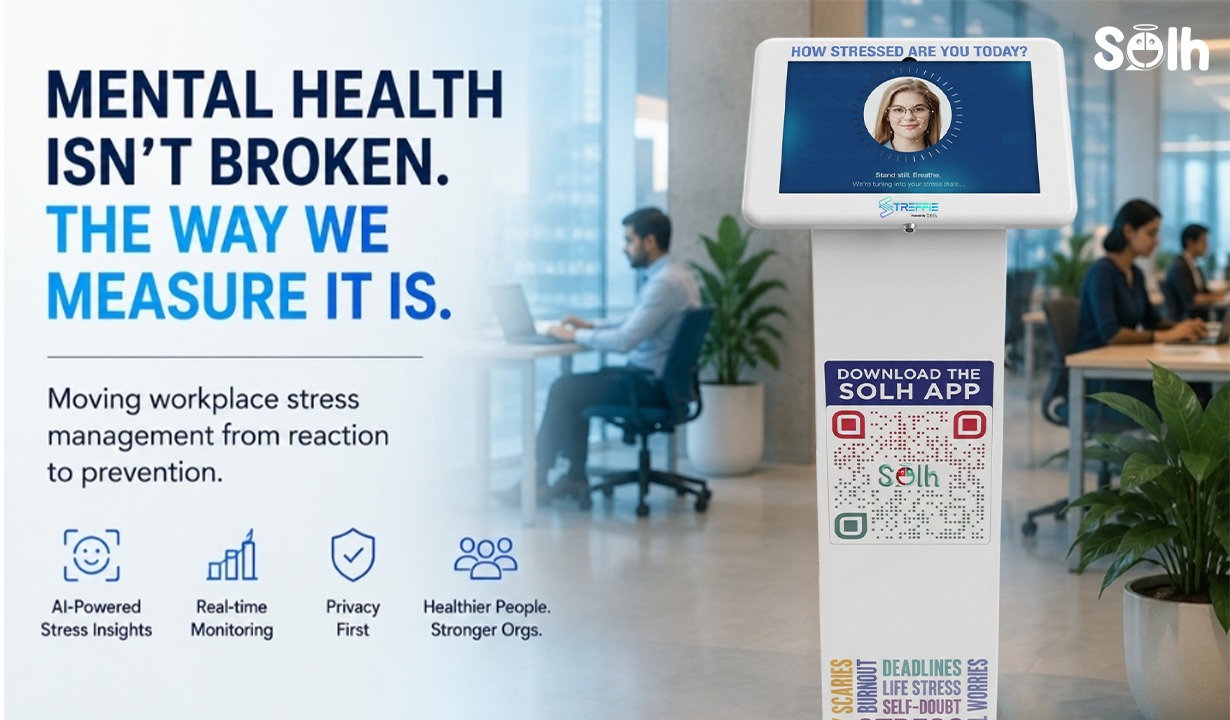
implementing real-time stress mapping
using AI-driven emotional support (Solh Buddy)
deploying scientific regulation plans across teams
redesigning workflows based on emotional bandwidth
train employees on nervous system intelligence
make Streffie scans mandatory for emotional climate checks
The future of employee well-being is not “feel-good.” See why the future of workplace well-being lies in measurable stress.
It’s functional, measurable, and mission-critical.
This shift defines the future of employee well-being in India — moving from wellness programs to operational infrastructure.
2026 Will Redefine Employee Well-being Because It Must
India cannot build a thriving economy with a collapsing emotional foundation.
Organisations cannot demand high performance from dysregulated humans.
And individuals cannot carry their emotional load alone.
For the first time, we’re acknowledging what truly drives performance:
Bandwidth.
Regulation.
Stability.
Emotional clarity.
This is not philosophy.
This is biology.
2026 is the year India steps into a new emotional era — one where stress is understood, regulated, and integrated into how we work, lead, build, and live.
The question is:
Will your organisation adapt?
Or will you keep calling it “a motivation problem” while your people quietly fall apart?
Let’s Connect!